Analysis on maritime carbon and resilience regulation
Published commentary on how carbon and resilience rules reach charter contracts, fleet decisions and financing.
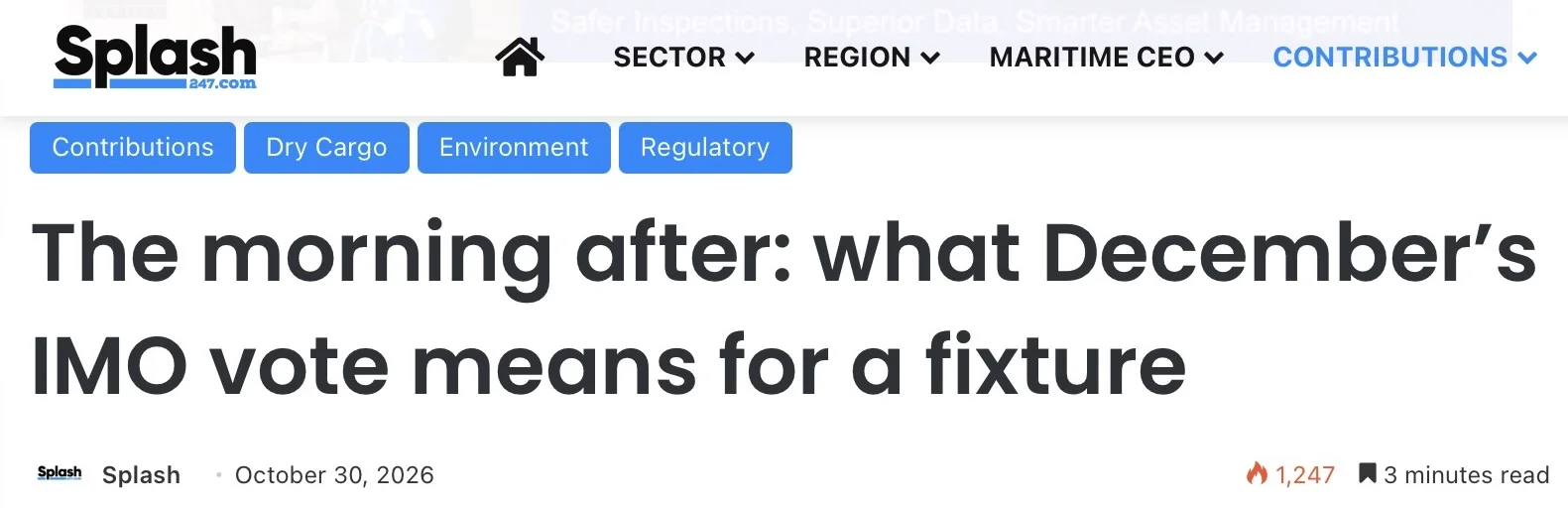
The morning after: what December's IMO vote means for a fixture
A Kamsarmax fixture reported in the market, priced twice: under the EU rules already in force, and with the global charge the IMO vote could add. The piece shows what changes in the voyage numbers the day after adoption, and who in the charter chain would carry it.
Read on Splash247 https://splash247.com/the-morning-after-what-decembers-imo-vote-means-for-a-fixture/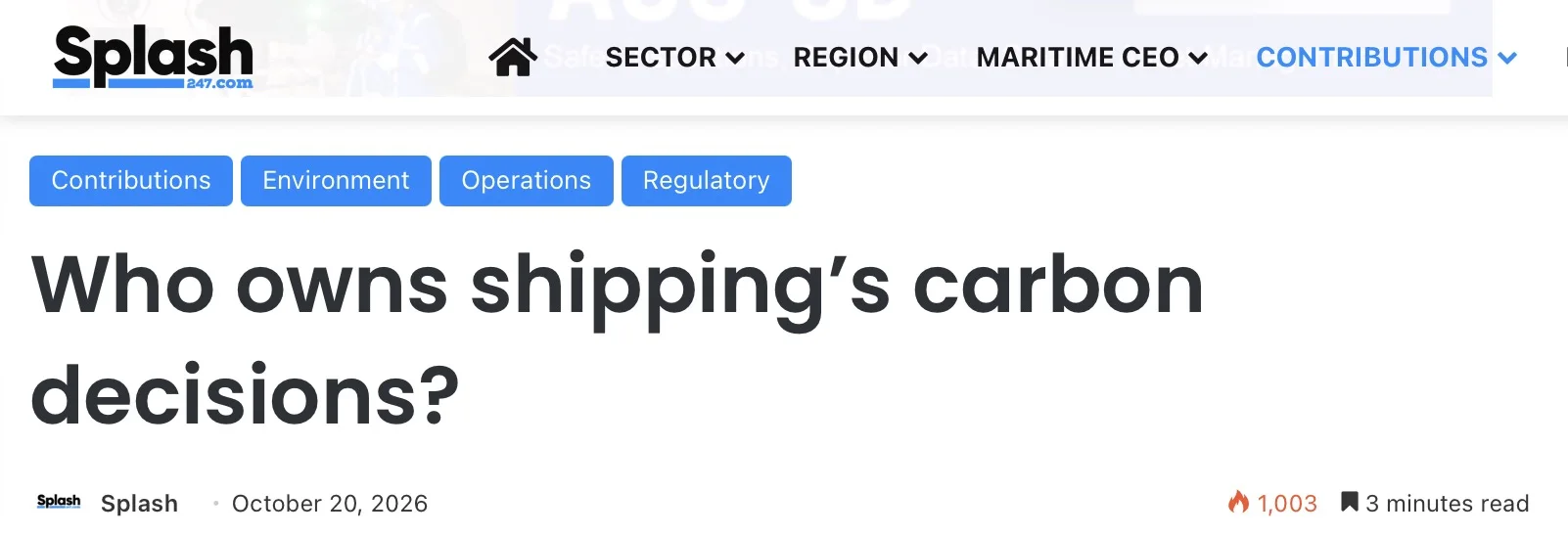
Who owns shipping's carbon decisions?
Carbon cost on a single voyage now grows year by year as FuelEU targets tighten. The article argues that the risk lies less in the tools companies use than in who inside the company holds the authority to decide on that cost.
Read on Splash247 https://splash247.com/who-owns-shippings-carbon-decisions/New articles are added here as they are published.
A fixture, a fleet, a loan book, and two timed answers
Short documents built on the tools, the way a desk would use them: inputs, assumptions, result and the decision it informs. Vessel archetypes, not named ships; no client data. Two were answered against a stopwatch: six and a half minutes for a fixture, four and a half for a fleet. Each opens here on the page, with a button to save the PDF.

One Capesize, five ETS clauses
Tubarão to Rotterdam, 175,000 t of iron ore, 821 allowances due eleven months after the freight was agreed. Fixed surcharge, index-linked, collar, shared adjustment and trigger band, each priced at five EUA levels with the owner's gain or loss, and the three things the clause has to name.
Read · 2 pages
One loan book, one carbon price
Eighteen financed vessels, €1.0bn of collateral, €550M of loans. The carbon bill at €85, €120 and €200 per allowance, carried step by step — annual cost, cash-flow impact, capitalised liability, haircut, LTV, LGD input — with every assumption on the page, so a credit analyst can repeat it on a calculator.
Read · 3 pages
Ten bulk carriers, one compliance year
An owner's fleet priced vessel by vessel: why EU share matters more than size, why one sister ship carries a fifth of the bill, why the pool saves nothing without a surplus ship, and what the same fleet owes in 2030, 2035 and 2040 as the targets and the multiplier tighten.
Read · 2 pages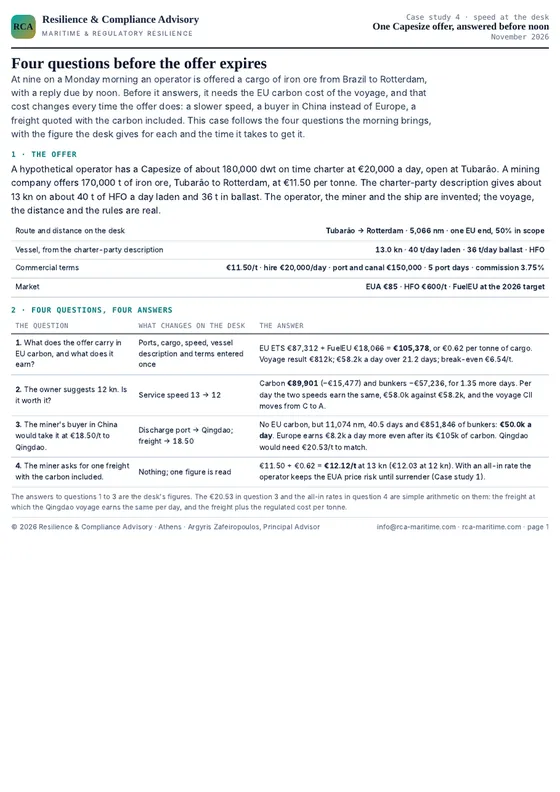
One Capesize offer, answered before noon
An operator has three hours to answer an offer that keeps changing: a slower speed, a buyer in China instead of Europe, a freight with the carbon included. Four questions, the figure for each, and the time it took to get it at the desk: six and a half minutes, measured with a stopwatch.
Read · 2 pages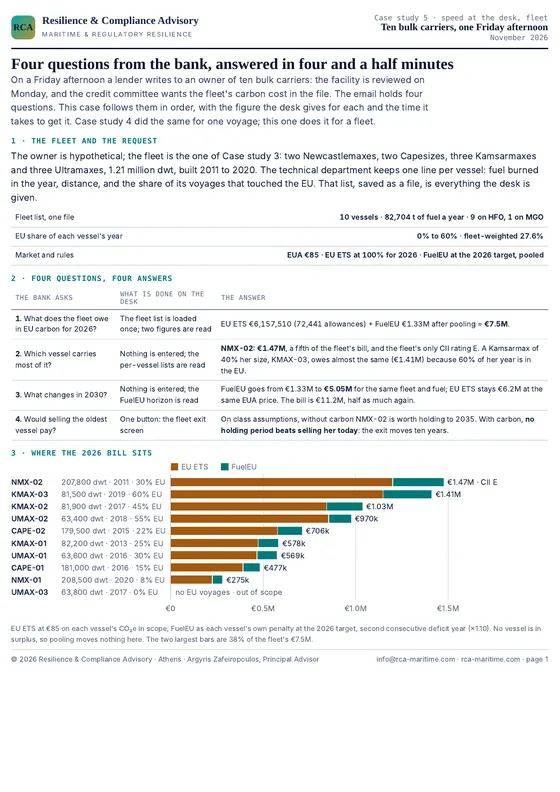
Four questions from the bank, answered in four and a half minutes
On a Friday afternoon a lender asks an owner of ten bulk carriers for the fleet's carbon cost before Monday's review: what it owes this year, which vessel carries most of it, what changes in 2030, and whether selling the oldest vessel pays. One fleet list loaded, nothing typed, each answer timed with a stopwatch.
Read · 2 pages
What carbon adds to this week's dry bulk voyages
Six typical voyages into Europe and into China, each with EU ETS and FuelEU as they apply today and the IMO Net-Zero Framework as a 2028 scenario: € per voyage, per day and per tonne of cargo, and what it means for the Atlantic Supramax and the Brazil–Australia spread.
Read · 1 pageFigures from MCCS Broker and Owner v4.24.6 and MCCS-BV v1.39, run 8 Nov 2026; case study 4 from MCCS Charterer v4.24.7 and case study 5 from MCCS Owner v4.24.8, run 12 Nov 2026. Illustrative: archetype vessels and stated inputs; not advice — see the legal notice. An end-to-end, anonymised voyage case, from recap to clause, follows in a later edition.