What carbon does to each loan's cash flow and collateral — on your own book, before the next review
MCCS-BV reads a shipping loan book the way credit reads it. For every financed vessel it prices EU ETS, FuelEU Maritime and the proposed IMO Net-Zero Framework, then carries the cost through disclosed rules to the borrower's debt service, the vessel's value as security, the loan-to-value and an LGD input — base and stressed, with the assumptions on the page. It is an input to the bank's own rating, collateral and RWA processes, not a valuation and not a PD.
Runs offline on your own computer · portfolio data stays on the bank's machines
2025 emissions are surrendered at 70% by 30 September 2026; 2026 emissions at 100%, surrendered in 2027. From then on it is a recurring cash cost on every EU voyage.
Intensity targets step down in 2030, 2035 and 2040. A ship's annual deficit, after banking, borrowing and pooling, is penalised at €2,400 per tonne of VLSFO-equivalent energy.
Climate factors are entering collateral valuation, and Poseidon Principles signatories report portfolio alignment every year.
One loan book, one carbon price
Eighteen financed vessels, €1.0bn of collateral, €550M of loans. At today's allowance price the carbon bill is €24.0M a year; carried through the LGD lens in six checkable steps it takes 16% off the collateral, moves the loan-to-value from 55% to 66% and the LGD from 30% to 46% — and at €200 the cover is close to gone. Half pass-through to charterers halves the effect. The two-page case, with the rule and every input stated, is on the Insights page.
Lender view
The portfolio as credit and risk teams read it.
Portfolio statusWhere does the book stand today?
Exposure across borrowers and segments, with the red flags that need follow-up first.
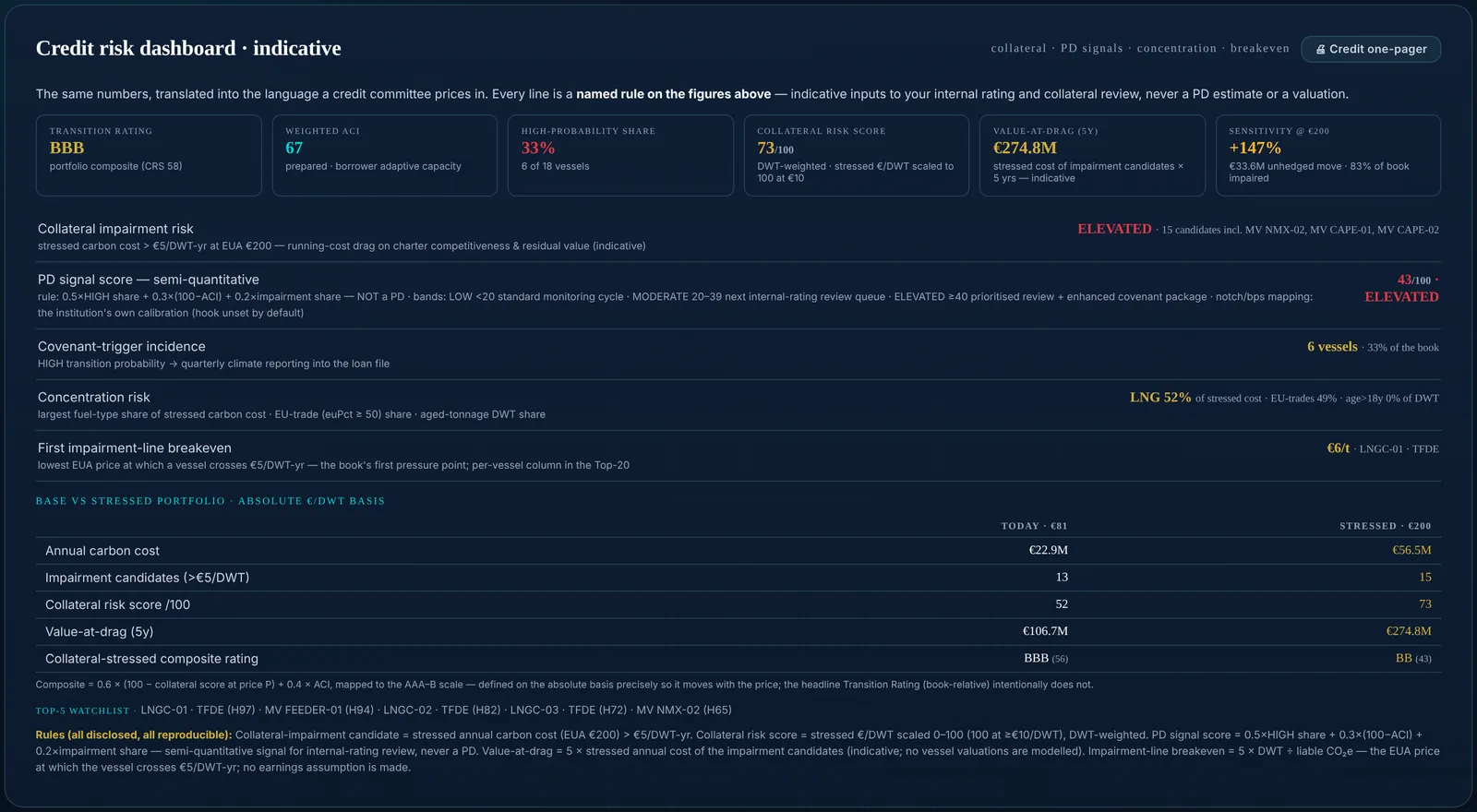
Credit risk dashboardHow far does the stressed case move?
Regulated cost per borrower and per loan, base against stressed, with named scenarios saved for committee.
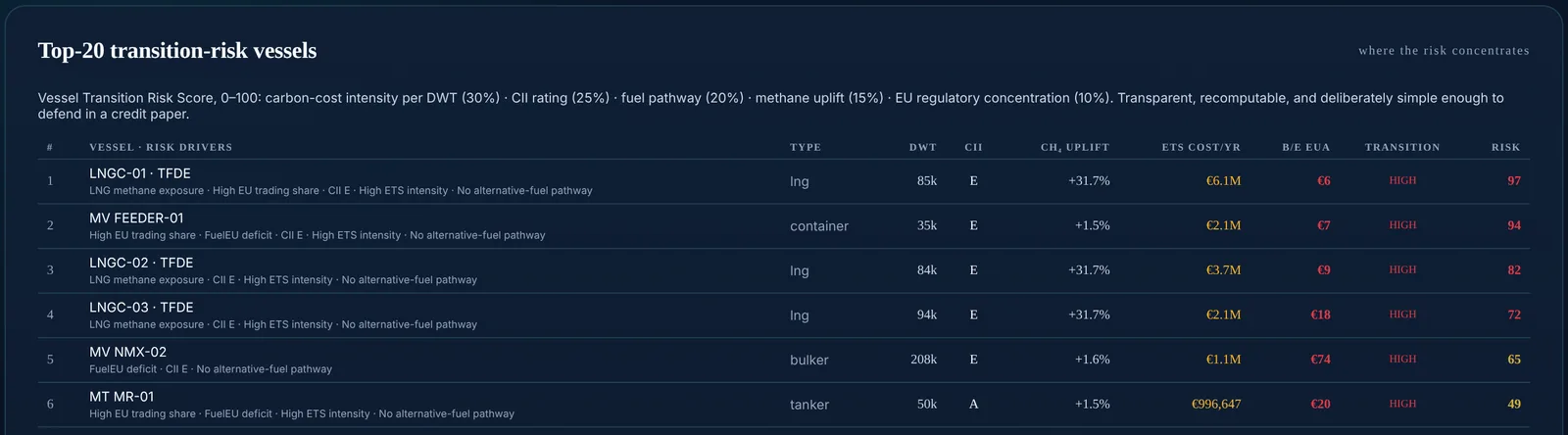
Top-20 transition-risk vesselsWhich ships carry the most risk?
The financed vessels ranked by transition risk, with a watchlist of stranded-asset candidates.
LGD lensHow does carbon reach loss given default?
The path from carbon liability to collateral value and loan-to-value over the life of the loan.
Climate-adjusted collateralWhat is the vessel worth with carbon priced in?
Vessel value reduced by the carbon liability it carries.
Decision supportWhat should the desk do tomorrow morning?
A short list of actions drawn from the red flags and the watchlist.
Stress & scenarios
Tests that credit committee can repeat.
Adaptation stress testWhat if the EUA price, target year or fuel mix changes?
One-click shocks on the main assumptions, applied to the whole book.
Policy sensitivity gridWhich assumption matters most?
Results across a grid of carbon price and policy settings.
Adaptive capacity indexCan the borrower absorb the cost?
A reading of each borrower's room to adapt the fleet.
IMO Net-Zero FrameworkWhat if the global charge is adopted?
Applied as an optional stress, separate from the base case.
Fleet & regulation
The rules applied to each financed vessel.
Fleet inventoryHow does the book get in?
Vessels added one by one or by bulk import, with a guided estimation wizard where borrower data is missing.
Emissions & GHG chainHow does fuel become a liability?
The chain from fuel burned to CO₂e and to regulated cost, with Scope 2 and 3 shown separately.
EU ETS exposureWhat does each vessel surrender?
Per-vessel ETS exposure on a CO₂e basis, with UK ETS maritime in the regime coverage.
FuelEU & flexibilityWhat can a borrower's own pool offset?
Penalty trajectory under the current fleet mix, the gross penalty against the pool, the flexibility mechanisms and the RFNBO reward.
CII screenWhich ships drift to D or E, and when?
Ratings today and along the tightening reduction path, vessel by vessel.
Poseidon Principles alignmentIs the portfolio on the trajectory?
Per-vessel intensity against the official trajectories, rolled up to portfolio level and weighted by debt outstanding.
Model governance
So credit and risk can defend the number.
Governance recordWhich assumptions produced this result?
Every assumption, factor and scenario stated and exportable.
Corrective-action checkDoes the borrower have a plan?
Whether a corrective action exists for each vessel that falls short.
| Step | What happens |
|---|---|
| 1 · Load | The shipping book: vessels, fuel, EU exposure, loan and market value. |
| 2 · Apply | ETS on a CO₂e basis, FuelEU well-to-wake, IMO NZF as an optional stress. |
| 3 · Stress | EUA price, target year and fuel mix, with the result exported for credit committee. |
A pilot on the bank's own portfolio
Pilot, then transfer
A supervised pilot on the bank's own portfolio, then a methodology transfer the bank owns, with no ongoing dependency.
Data stays with the bank
The tool runs locally in the browser, so portfolio data stays on the bank's machines. It complements existing risk systems as a quantification layer and replaces none of them.
DORA advisory on ICT risk and third-party providers can run in parallel, for banks that need both.